The following is a sermon preached at Redeemer Church on 4.28.24.
What is life supposed to look like? How often does your life look and feel like it’s supposed to? But do you see what I did there? I slipped in “supposed to,” and that’s the whole question. We often feel like our life is a mess meaning it isn’t what it’s supposed to be, but can we even articulate what it’s supposed to look like?
We know Leave It to Beaver is a joke. But we often do expect something a little more like Andy Griffith or Family Matters or at least Seinfeld. I mean they all ended up in jail, but still! The world Jerry and Elaine live in seems more tame and less disorienting than our lives sometimes.
What is challenging is that every time you land on certain words to describe what life should be like, you immediately want to qualify those words: Life is supposed to be happy … well, I mean … Life is supposed to be good … I mean, yeah but …
I submit to you this morning that according to Moses and Jesus the life we are called to is a hard life of flourishing.
We are going to start in Deuteronomy 4 this morning so if you have a Bible turn there with me. In this text, Moses calls us to cling to God’s instructions, and time and time again the biblical story shows us that clinging to God’s instructions means embracing the hard life. But why is that? Is it because God’s instructions are inherently hard? No, it’s because the world we live in pulls us in other directions, and we feel that pull at the deepest level of our being, in our desires. But if we resist and cling to God’s instructions, we find that even in the wilderness we are accompanied by God’s presence and peace.
We can’t answer the question what’s life supposed to be like by just saying the three words “a hard life” because when we cling to God’s instructions he empowers us supernaturally to say things like “I count all that I’ve lost rubbish in light of the surpassing worth of knowing Christ (Phil 3:8). And it’s not just a hard life that leads to flourishing because even in the midst of the difficulties, with the Spirit Paul can say, “I have learned in whatever situation I’m in to be content” (Phil 4:11).
One of the most encouraging things about regularly reading and meditating on and living with Scripture is when you see your world within its pages. Framing the call of God in terms of “the hard life of flourishing” helps us see the nexus of the Old Testament, the New Testament, and our own lives. It’s like a breath of fresh air to know that your experience is on God’s radar. Hardship and flourishing is a helpful way to hold together the way we struggle and the way God’s presence meets us there in the midst of it all.
Many of you this morning are walking the hard-life-path, and I hope you hear the gospel of our Lord that says, “You’re flourishing.” Flourishing are those who mourn … flourishing are those who hunger and thirst for righteousness,” not because mourning or hungering for God’s justice is a wonderful experience in and of itself, but because in light of this broken world, that’s the place where God’s presence is found. Our Lord was identified with Isaiah’s servant, a Man of Sorrows acquainted with grief, and when you find that title fitting for your own life as you struggle to obey the Lord and hold on, there is sweet communion and solidarity with God himself.
Some of you, perhaps, feel the pull away from God’s instructions, and I hope you hear the call of Moses and Jesus, the call of the Spirit, that says, “I know that way looks better, but the hard life of following my instructions is the path of true life.”
Moses and the hard life of flourishing
In Deuteronomy 4, Moses is very much concerned to shape the Israelites’ expectations concerning what life should look like. Moses knows his days are coming to a close, and he spends the whole book of Deuteronomy urging Israel that the only way to flourish and live well in the land is to cling to God’s instructions. Look at verse 40 with me, this is where he is headed:
Therefore you shall keep his statutes and his commandments, which I command you today, that it may go well with you and with your children after you …
Now, let’s back up and see how Moses gets to this conclusion. Keep the commandments so that you can live well, that’s the conclusion to the whole first four chapters, but Moses starts a recap of the first four chapters in verse 32. Read verses 32–33 with me:
For ask now of the days that are past, which were before you, since the day that God created man on the earth, and ask from one end of heaven to the other, whether such a great thing as this has ever happened or was heard of. Did any people ever hear the voice of a god speaking out of the midst of the fire, as you have heard, and still live?
Scripture calls us to consider everything from creation to Sinai. When he mentions the voice of God speaking out of the midst of fire, he’s talking about Mount Sinai. Moses is emphasizing God’s presence with his people. The rhetoric is one hundred percent supernatural. God himself has miraculously cared for and provided for his people since the beginning, that’s the point, and therefore his people on the plains of Moab can count on him to continue to do the same. Let’s follow Moses’s lead and ask of the days of old.
“Ask of the Days of Old”
What is life supposed to look like? In the beginning, people were created to flourish, and yet there’s a snake. There’s a message that stands in opposition to God’s instructions, and wouldn’t you know it, that message slithers down into Adam and Eve’s mind and heart and entangles their desires. All of the sudden choosing and holding to God’s good instructions becomes hard.
God calls Abraham, and he says, “Abraham, I’m going to do amazing things with you! Adam and Eve and Cain and the whole crew let the curse in, but through you all the families of the world will be blessed!” This time it wasn’t a snake and a piece of fruit. Abraham and Sarah were entering Egypt, and Abraham was worried that his life was going to get caught between violent men and his beautiful wife. What if they kill me to take my wife? So he lies and exploits his wife.
Later, the problem was the clock. God wasn’t acting fast enough to bring about the son he promised Abraham and Sarah, and so they took advantage of Hagar. Abraham carries forward the pattern of the garden right into his family. Abraham, Isaac, and most certainly Jacob become known for the way they scheme and lie and deceive to get good on their own terms. They have the hardest time embracing God’s good instructions.
Abraham’s family ends up in Egypt in slavery, and God hears their cries for help. Oddly enough, though, God leads them into the hard life of the wilderness. “Hard life” is such a difficult phrase because not every hard life circumstance is of God. The snake wasn’t from God, Pharaoh’s awful slavery, his murder of their children, wasn’t from God. Think about Hagar! The abuse she suffered at the hand of Sarah wasn’t from God. But then there’s the wilderness that God led his people into immediately after saving them from slavery.
In the wilderness, Israel tries their best to find an easier way. Ten times they put God to the test, demanding an easier life. They were ready to kill Moses and Aaron, but can we not sympathize with that inclination? Not the killing part but the abandoning the hard way part. Doesn’t it make sense so many days to throw in the towel and go back to Egypt where there were pots full of meat?
It is comforting to see our experience of failure in the pages of Scripture, but it’s even more profitable to listen to God’s words of comfort when he says, “You don’t have to stay there in your fear and rebellion because … I am with you. Yes, he led them into the wilderness, but he also led them by a miraculous pillar of fire and cloud. He provided food in the wilderness. Their clothes didn’t wear out for forty years. He made water gush from the rock. Read verses 33–39 with me:
Did any people ever hear the voice of a god speaking out of the midst of the fire, as you have heard, and still live? Or has any god ever attempted to go and take a nation for himself from the midst of another nation, by trials, by signs, by wonders, and by war, by a mighty hand and an outstretched arm, and by great deeds of terror, all of which the LORD your God did for you in Egypt before your eyes? To you it was shown that you might know that the LORD is God; there is no other besides him. Out of heaven he let you hear his voice, that he might discipline you. And on earth he let you see his great fire, and you heard his words out of the midst of the fire. And because he loved your fathers and chose their offspring after them and brought you out of Egypt with his own presence, by his great power, driving out before you nations greater and mightier than you, to bring you in, to give you their land for an inheritance, as it is this day, know therefore and lay it to your heart, that the LORD is God in heaven above and on the earth beneath; there is no other.
What’s life supposed to look like? It is hard, and there is flourishing. It’s both, and there’s no easy way to order those terms. When you meditate on Scripture and ponder its message, there is some logic to why our experience is both hard and flourishing. Our experience is marked by an overlap of heaven and earth. We are comforted by God’s Spirit, his revelation, his voice, and his people, but we dwell in a broken world with broken bodies and unwhole hearts. The hope of the gospel is that one day all things will be made new.
This is why Moses calls us to cling to God’s instructions. The instructions themselves are little beams of heaven that have broken into our world. God has always made a way for those who will hear his voice and respond to the call, “Follow me.”
Jesus and the hard life of flourishing
We should at this point lift our heads out of Deuteronomy. It is the Easter season after all. We don’t have to limit our answer to our question to the revelation of God at Sinai. Yes, God showed up on the top of Mount Sinai and he spoke from the cloud, but there’s another mountain and another cloud from which God spoke.
In Mark 9, at the top of another high mountain, God spoke from another cloud and gave instructions, really concise instructions. Do you remember how he said it at Jesus’s transfiguration? The fabric of our world was peeled back, and for just a minute they saw Jesus really and truly. With Moses and Elijah flanking both sides of Jesus as witnesses and symbols of God’s past presence with his people, the Father showed up and said three words: “Listen to him.” Moses called us to cling to God’s instructions as life, and he gave us the Torah. The Father points to an embodied fulfillment of the Torah and simply says, “Listen to him.”
The timing of this event in Mark is very intentional. Jesus had just begun telling his disciples that he was going to suffer, die, and rise again. Their response was very much like our response when we hear Jesus calling us to the hard life, the hard way. Peter said, “That’s ridiculous, Jesus! That can’t be right.” Turn with me to Mark 8:32.
As you find your place, look at verse 31. This is where Jesus began to reveal what was going to happen to him. Now look at verse 32. The first five words:
And he said this plainly.
In multiple ways, Mark shows us how important it was for Jesus to be heard on this specific point: What is life supposed to look like? Look at verses 32–33:
And Peter took him aside and began to rebuke him. But turning and seeing his disciples, he rebuked Peter and said, “Get behind me, Satan!
I discussed this passage with a few groups of ninth graders recently, and one girl raised her hand and asked, “Why would he call Peter Satan? Peter was just trying to protect Jesus and do what’s good for him.” That’s the rub isn’t it.
Everything within us says that Jesus’s words are not what is good for us. I don’t know what else to conclude from Jesus’s response to Peter but to say that there are ways we can move towards comfort that are satanic, meaning there are ways we can take steps towards comfort that are actually steps away from God. Separation from God and flourishing, isn’t that what the snake’s advice brought about in the garden? Isn’t that what happened when Israel wanted to go back to Egypt instead of following the scary path into the promised land? It looked better to stay in the wilderness, but it led to separation from God’s presence and separation from flourishing.
There is one more observation I want you to see in Mark 8: What is Jesus concerned about when he takes such a sharp tone with Peter? Look at what Mark shows us in the first six words of verse 33:
But turning and seeing his disciples …
Mark is showing us that Jesus was concerned about the effect of Peter’s words on his disciples. Peter’s words to Jesus have a lot of import for what it means to follow Jesus. Apparently, for Jesus, this isn’t just about what his life should look like. It’s got implications for his followers — Why else would Mark preface “Get behind me, Satan!” with the words “turning and seeing his disciples”?
Look at verses 34–35, the very next thing Jesus does shows us that we are on the right track:
And calling the crowd to him with his disciples, he said to them, “If anyone would come after me, let him deny himself and take up his cross and follow me. For whoever would save his life will lose it, but whoever loses his life for my sake and the gospel’s will save it.
There is an administrator at our school who has significantly impacted my life, and this particular administrator has a personal liturgy that he says almost every time he prays in public: “Must Jesus bear the cross alone, and all the world go free? For there’s a cross for everyone, and there’s a cross for me.”
You might object to that line, and say, “Jesus bore the cross so I don’t have to!” And there’s some truth to that. Jesus bore HIS cross so you don’t have to bear HIS cross. He did a unique thing. He bore the sin of the world. Nevertheless, as we follow our Lord, and I say this with fear and trembling, we must take up OUR cross and follow him. We don’t bear his cross, but you heard him say, “Take up your cross.” I don’t know what else to call that except a call to a hard life.
In Mark, this call, this story, this scene immediately precedes the Father showing up on the top of the mountain, peeling back the curtain of our world, and saying, “Listen to him.”
What does it look like?
The details of “taking up your cross” requires wisdom from God’s Spirit. What did Jesus do that made his life so hard? He showed compassion to people. He listened to his Father and the Torah instead of conforming to the expectations of people. He showed kindness and mercy to people that he wasn’t supposed to. He held the line. He told people committing social injustice that they had polluted God’s house, and he even flipped over some tables and ran off a bunch of crooks with a whip. Sounds like the good life to me, but the world he lived in didn’t think so. What is life supposed to look like? Those good actions of our Lord were met with crowds and busy, praise and slander, spit and betrayal, and asphyxiation.
It’s hard to look sometimes, but we have to fix our eyes on Jesus, who for the joy set before him endured the cross. I asked the ninth graders to draw what they imagine as they hear Jesus’s words in Mark 8:31–35, and I want to show you a few of the images.
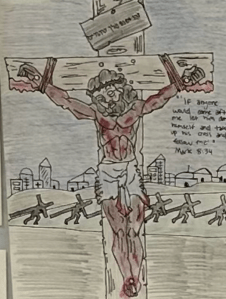
This picture was drawn by a young man named DJ. In his picture, I love the series of followers behind Jesus carrying their cross.
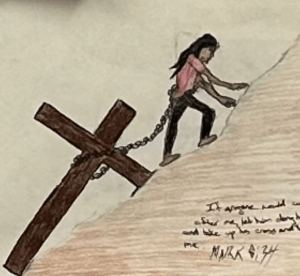
The next one is from Jacob Scott, and I like how the struggle in Jacob’s picture is framed, primarily, in terms of climbing a hill; secondarily, you see that the hill climbing is cross-bearing. Who knows what it will look like to follow God’s good commands in this world? Cross-bearing takes many forms.

The last two are to me even more insightful. This one is from a young man named Deji. The words on the cross say, “For whoever would save his life will lose it, but whoever loses his life for my sake and the gospel’s will save it.” You all in this room bear the cross of Christ in many different ways, and I hope you feel his comfort this morning. I hope you hear him saying, “I felt the pain, too.” Notice how there’s no blood in Deji’s picture. Even in Mark 3, well before the passion week, Jesus knew the hard life. Before the passion week, he knew what it was like to be so busy that he had no time to eat (Mark 3:20). He loved his own even to the end, and he now shares in the joy of resurrection.
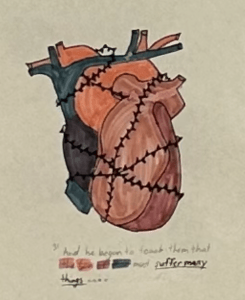
The final one is from a young lady named Jordan. This one is a little more abstract and might capture your experience better. What does it look like to choose a hard life for Jesus’s sake? This picture captures how the battle to stay with the Father in Gethsemane takes place at the level of our desires.
As the homily portion of our worship comes to a close, the topic of the heart brings us back to Deuteronomy. In Deuteronomy, Moses calls us to cling to the LORD with all our heart, and the gospel is that the ability to do this is exactly what was promised to us in the new covenant. The writer of Hebrews quotes Jeremiah to exalt the work of Christ on our behalf. He says,
The Holy Spirit bears witness … for after saying, “This is the covenant that I will make with them after those days, declares the Lord: I will put my laws on their hearts, and write them on their minds,” then he adds, “I will remember their sins and their lawless deeds no more.” Where there is forgiveness of these, there is no longer any offering for sin.
You might say, “I hear you, Brian, about sin and forgiveness, but what am I supposed to do with that? Life’s hard! Where’s the help with the now? You have to keep reading. Listen to the very next verse:
Therefore, brothers, since we have confidence to enter the holy places by the blood of Jesus, by the new and living way that he opened for us through the curtain, that is, through his flesh, and since we have a great priest over the house of God, let us draw near with a true heart in full assurance of faith, with our hearts sprinkled clean from an evil conscience and our bodies washed with pure water. Let us hold fast the confession of our hope without wavering, for he who promised is faithful (Heb 10:16–23).
Forgiveness and cleansing from sin have always been tied explicitly to access to God’s supernatural presence and help. “I’m with you until the end of the age,” Jesus said (Matt 28:20). “It is the LORD who goes before you. He will be with you. He will not leave you or forsake you,” Moses said. What is life supposed to look like? Listening to Moses and following Jesus means walking with the Spirit who leads us beside still waters, flourishing even in the hard life.
☩ In the name of the Father, the Son, and the Holy Spirit. ☩
 Brian W. Davidson
Leave a comment