Daniel Block has convinced me that I have misunderstood that statement. The narrator of Judges says,
“There was no king in Israel. Everyone was doing what was right in their own eyes” (Judges 17:6, et al.).
What is he getting at by saying, “There was no king in Israel”? I’ve always read that as foreshadowing the coming of the monarchy, and it certainly is at least that. But the question is this: Is the narrator saying that Israel needs a king? After reading Block today, I don’t think that is the point.
A Different Take
Block notes that the narrator is writing with a clear understanding of Israel’s history. The narrator knows that the kings will only lead to exile. Block observes that “doing what is right in your own eyes” versus “doing what is right in the eyes of Yahweh” comes from Deuteronomy (12:8, 25, 28). The kings of Israel are repeatedly denounced for acting just like the Judges generation. They all refuse to do what is right in the eyes of Yahweh (see the notes below), which is synonymous with doing what is right in your own eyes. Since the narrator knows that the kings are going to act just like the people in Judges, it wouldn’t make sense for him to be longing for the monarchy in Judges.
The narrator is saying something like this: In those days there was no king to blame. It was the people. Everyone was doing what was right in their own eyes. Just like the kings will do in the books to come, so the people did before the kings. The blood of exile is on everyone’s head.
Yes, “in those days there was no king” foreshadows the coming monarchy, but it doesn’t commend it as a solution. It’s step one of a two step denouncement of the Judges generation in light of what readers (and the writer) know about the kings.
Notes
Here is Block on how the monarchy resembles the Judges generation:
Kings who are denounced for not doing what is right in the eyes of Yahweh, i.e., who did what was right in their own eyes, include Solomon (1 Kgs 14:8), Jehu (2 Kgs 10:30), and Ahaz (2 Kgs 16:2). Several others are commended for doing what was right but are still said to have fallen short of the ideal in failing to remove the high places: Asa (1 Kgs 15:11–14), Jehoshaphat (1 Kgs 22:43), Jehoash (2 Kgs 12:2–3 [Hb. 3–4]), Amaziah (2 Kgs 14:3–4), Azariah (2 Kgs 15:3–4), Jotham (2 Kgs 15:34–35). Only David (1 Kgs 22:2), Hezekiah (2 Kgs 18:3), and Josiah (2 Kgs 22:2) receive unqualified commendation in this regard. But even David, who is put forward as the model of doing what is right in the eyes of Yahweh (1 Kgs 11:33, 38), is acknowledged to have fallen short of the ideal in his crime against Uriah the Hittite (1 Kgs 15:5).1
Here are his comments on Judges 17:6:
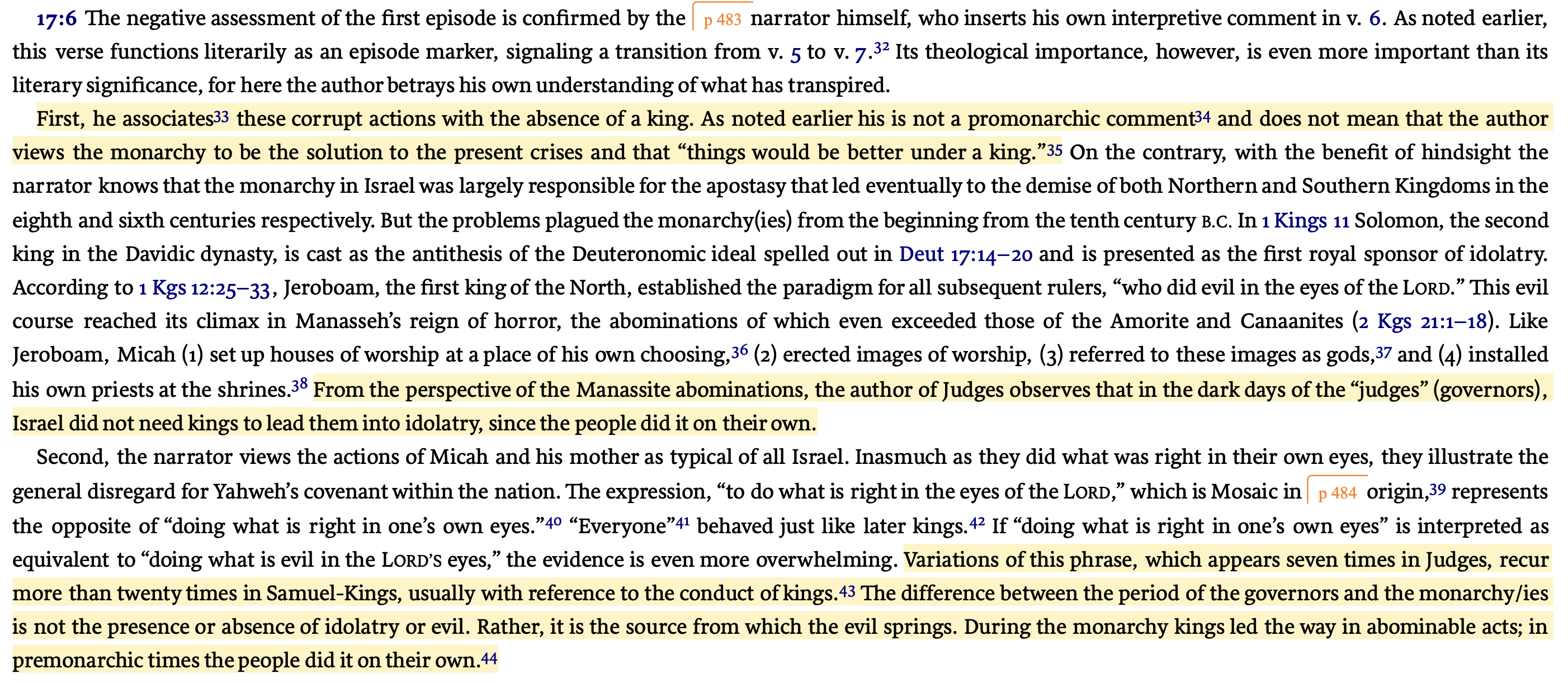
- Daniel Block, Judges, Ruth in The New American Commentary, vol. 6 (Broadman & Holman Publishers, 1999), ft. nt. 42 on p. 484. ↩
 Brian W. Davidson
Leave a comment