Jeremiah 4 is a message of hope against hope. Disaster is imminent (4:5–28) and unchangeable, and yet repentance still does something meaningful (4:1). God is still dedicated to the covenant he made with Abraham (4:2). A hat is tipped to the coming seed of Eve, Abraham, and David. The call to internal renewal, heart circumcision, is still in effect (4:3–4). Everything is about to change for God’s people, but in reality nothing has changed. This chapter is a tragic picture of coming disaster, one that ends with the prophet fainting before murderers, but therein lies the beauty. Even in this darkness, Jeremiah says the foundational hope of God’s people is still living and active.
Hope
Jeremiah roots the hope of God’s people in the promises God made to Abraham and David and Moses (4:2). Jeremiah warns that the core problem is far deeper than a national issue or an individual issue. It isn’t about mere bureaucracy or personal vices. It’s the inner world of every person, the heart, the desires, the nature of humanity (4:3–4). This was the same diagnosis Moses gave (Deut 10:16; 30:6). They need to circumcise and cleans their hearts so that they can be saved. Jeremiah 4:2 points the way forward with the subtle mention of a singular him at the heart of the promise to Abraham (Gen 12:3, et al.). The faithful remnant have hope in the face of death because God spoke new creation life to Abraham, and that good Word echoes through the Torah and Prophets, through exile, and through death.
It is a singular “him” (בוֹ) who will ultimately fulfill the conditional that opens the chapter: “If you will turn … if you will remove your abominable deeds …” (4:1). When Jesus came he identified with Israel and perfectly lived the life every human being failed to live. He fulfilled Jeremiah 4:1 and he unleashed the promise of Abraham (Jer 4:2) to all nations through the gift of the Spirit. We heed Jeremiah’s call by clinging to hope in him through all of life and our own death.
Structure
Part 1: Hope (4:1–4)
- Call to repentance (4:1–2a)
- The hope of the promise given to Abraham (4:2b)
- Call for heart circumcision (4:3–4)
Part 2: Against Hope (4:5–31)
- Introduction: The sound of coming disaster (4:5–8)
- Body: A Vision of the Day (4:9–28)
- Undoing of all leadership (4:9–10)
- The north wind of destruction and the heart of the problem (4:11–18)
- Lament and the reason for the disaster (4:19–22)
- Four “I see” statements and the undoing of Genesis 1–2 (4:23–26)
- Conclusion to the vision: Summary, a hint of covenant keeping restoration, Yahweh’s word as the ultimate cause, and the definite nature of the coming day (4:27–28)
- Conclusion: (4:29–31): The sound of coming disaster and fainting before murderers
Notes on Part 1: Hope (4:1–4)
The following are exegetical notes from which the previous sections were written.
4:1
Israel wanders like Cain, but for Israel that fate is reversible. If they will repent, they will no longer wander.
4:2
Fulfilling the promises to Abraham is still a possibility for Israel (see 3:16–18, too), but note the singular “him”:1
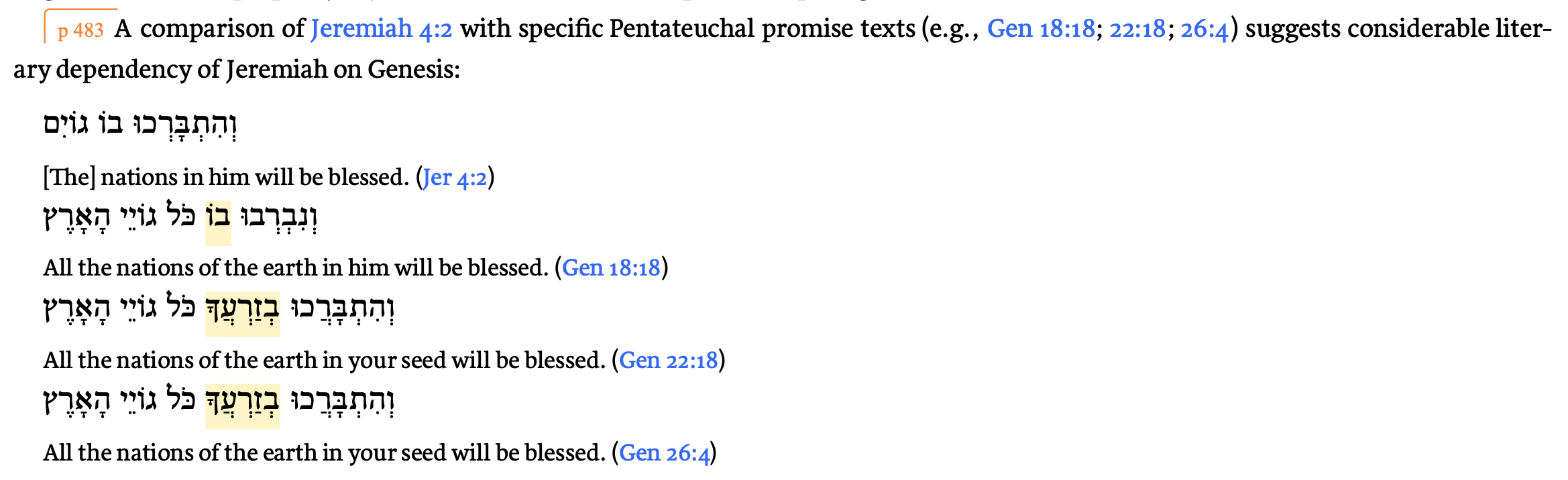
Sailhamer takes Jeremiah 4:2 as an early singular interpretation of the “seed” promise that runs throughout Genesis (Gen 18:18; 22:18; 26:4, going back to 12:3).
Thus, the role of Jeremiah 4:2 within the book as a whole is much like that of Genesis 3:15. The author uses the very ambiguity that we, as readers, find so troublesome. Ambiguity in these texts is a mechanism for sharpening the reader’s focus. It is a central part of the authors’s strategy in both texts.2
I find Sailhamer’s take compelling. Holladay takes him as a reference to Yahweh, which isn’t wrong either.3
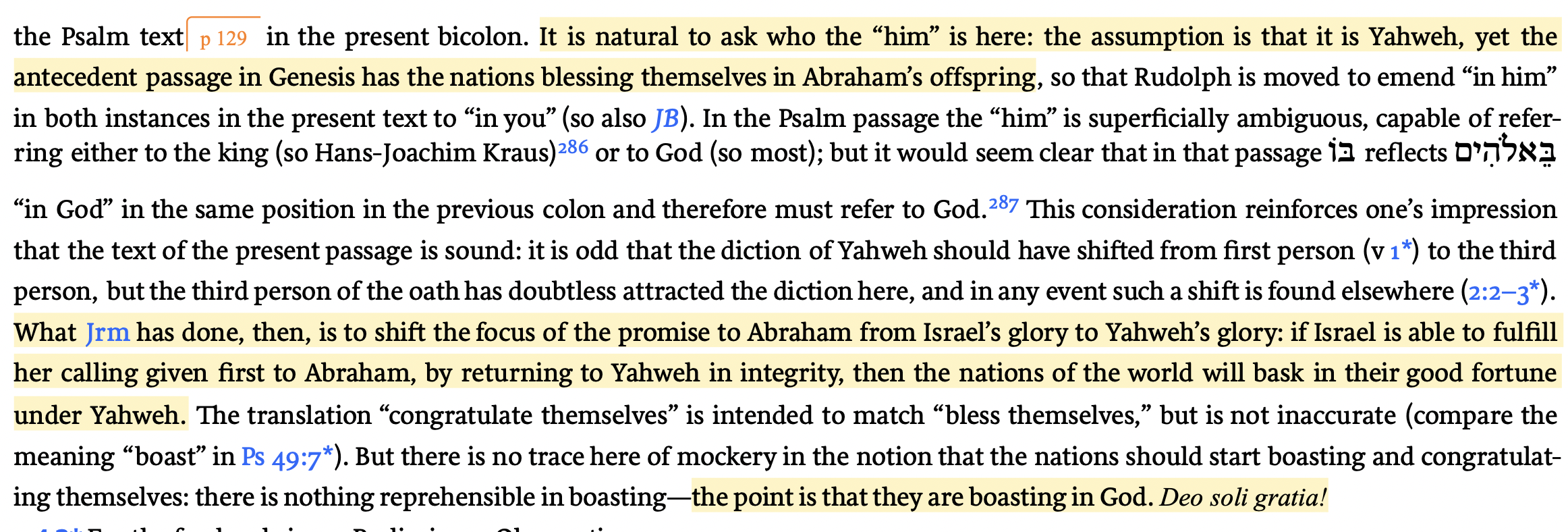
It’s both. As it turns out, the Messiah, the singular seed, is consubstantial with the Father and Spirit.
4:3
Jeremiah 4:3 provides an introductory metaphor for heart circumcision, which is explicitly the topic in the next verse. The introductory metaphor is one about sowing, “Don’t sow among thorns.” Sowing, thorns, and heart circumcision together — This sounds like the parable of the sower. Jesus likens the kingdom to sowing, some among thorns. He and his word would then be the means through which the Spirit circumcises the hearts of “good soil.”
4:4
Jeremiah calls the people of Judah and Jerusalem to circumcise their hearts just like Moses in Deuteronomy 10:16. Above, in 3:17, he provided an eschatological vision of Jerusalem filled with people who no longer follow their stubborn hearts. Perhaps those people circumcised their own hearts like 4:4 is calling for here (and Deut 10:16 called for), but more likely in light of how the story goes, Yahweh circumcised those people’s heart, like Deuteronomy 30:6 promised, through the coming of the Messiah and the gift of the Spirit.
Notes on Part 2: Against Hope (4:5–31)
Exegetical notes on part 2
4:5–8
Sounds of destruction — Verses 5–8 read like an introduction to the the vision that will occupy verses 9–28. Verses 5–8 would then be the introduction that functions parallel to the conclusion of verses 29–31.
4:9
“On that day” (וְהָיָה בַיּוֹם־הַהוּא) — Here begins a vision of destruction that culminates in four “I see” statements in verses 23–26, a clear statement of decreation in terms of return to Genesis 1:2, and the conclusion in 4:28.
4:14
In the midst of the pronouncement of destruction, Jeremiah returns to the call for the people to purify their hearts (see 4:3). Here, it isn’t “heart circumcision,” but “wash your heart from evil” (כַּבְסִי מֵרָעָה לִבֵּךְ) so that you may be saved. Cleansing the heart is the precursor to salvation. Jeremiah is, in effect, begging for the coming of the Messiah and the gift of the Spirit. He doesn’t realize it, but the seed of Abraham (4:2, בוֹ) will come and fulfill every expectation for God’s people and lead God’s people into deeper communion with him.
4:18
Again, Jeremiah highlights how the people’s corruption has reached their hearts. The last instance of corrupt heart language was in 4:14.
4:22
Jeremiah 2:8 and 4:22 decisively put to rest the idea that “knowing” stands in tension with transformation and true spirituality. Along with all the other ways Jeremiah talks about the the people’s corrupt heart stands this assertion: They don’t know Yahweh. If they knew Yahweh, they would not live like they do. In this verse not knowing Yahweh (אוֹתִי לֹא יָדָעוּ) is parallel with not knowing how to do good / live well (וּלְהֵיטָיב לֹא יָדָעוּ).
4:23–26
This is the climax of the vision that started in verse 9.
- “I see” the undoing of the filling done in Genesis 1.
- The land is decreated, תֹהוּ וַבֹהוּ.
- In the sky lightless, אֵין אוֹרָם.
- “I see” the undoing of the forming done in Genesis 1.
- The mountains shake.
- The hills become are undone.
- “I see” the undoing of the land creature and the sky creature.
- Humanity is no more.
- The birds of heaven are no more.
- “I see” the undoing of the garden of Genesis 2 and civilization.
- The garden has become a desert.
- Cities are destroyed.
4:27
A summary statement and a subtle hint at God’s mercy and covenant keeping: “The whole land will be a desolation, but I will not bring it to an end” (וְכָלָה לֹא אֶעֱשֶׂה). This sounds a lot like 2 Peter 3:10, but explicitly like the THGNT rendering and not like NA28:
| THGNT — no οὐχ | NA28 — οὐχ |
|---|---|
| ἥξει δὲ ἡμέρα κυρίου ὡς κλέπτης, ἐν ᾗ οἱ οὐρανοὶ ῥοιζηδὸν παρελεύσονται, στοιχεῖα δὲ καυσούμενα λυθήσεται, καὶ γῆ καὶ τὰ ἐν αὐτῇ ἔργα εὑρεθήσεται. | Ἥξει δὲ ἡμέρα κυρίου ὡς κλέπτης ἐν ᾗ οἱ οὐρανοὶ ῥοιζηδὸν παρελεύσονται, στοιχεῖα δὲ καυσούμενα λυθήσεται, καὶ γῆ καὶ τὰ ἐν αὐτῇ ἔργα οὐχ εὑρεθήσεται. |
Creation is returned to decreation, but there is not complete end as could be implied by οὐχ εὐρεθήσεται. The reading in NA could stand without contradicting Jeremiah here. I just find the conceptual parallel interesting to think about.
4:28
Summary statement, a conclusion to the vision:
- Reason: “This is why” עַל־זֹאת
- Restatement: the earth will mourn and the sky will go dark
- Ultimate cause is Yahweh: “Because” (עַל כִּי) I have spoken, I’ve planned (דִבַּרְתִּי זַמֹּתִי). Yahweh spoke creation in to being, and he has spoken. Decreation is coming.
- Definite: “I won’t relent or turn back from it.”
4:29–31
More sounds of destruction — Verses 29–31 are the conclusion to part two, the entire statement of destruction, parallel to the introduction in verses 5–8.
Footnotes
- John Sailhamer, The Meaning of the Pentateuch: Revelation, Composition, and Interpretation (IVP Academic, 2009), p. 483ff. ↩
- Sailhamer, The Meaning of the Pentateuch, 494. ↩
- William Holladay, Jeremiah 1: A Commentary on the Book of the Prophet Jeremiah, Chapters 1–25 in the Hermeneia series (Fortress Press, 1986), p. 129 ↩
 Brian W. Davidson
Leave a comment