The author of Hebrews makes clear what he is doing with Melchizedek. This is something I was excited to talk to colleagues about today as we prepped a lesson on Jesus’s ascension and priesthood.
Take a look at Hebrews 7:3. In this verse, the author introduces both Melchizedek and the way he is thinking about Melchizedek in relation to Jesus:
ἀπάτωρ ἀμήτωρ ἀγενεαλόγητος, μήτε ἀρχὴν ἡμερῶν μήτε ζωῆς τέλος ἔχων, ἀφωμοιωμένος δὲ τῷ υἱῷ τοῦ θεοῦ, μένει ἱερεὺς εἰς τὸ διηνεκές.
Without father, without mother, without genealogy, having neither beginning of days nor end of life, resembling the son of God he remains a priest forever. (Hebrews 7:3)
What I want to highlight is how the verse shows that the author is thinking textually about Melchizedek. He’s thinking about him as a character in a story in a book, and for him this is a matter of life and death.
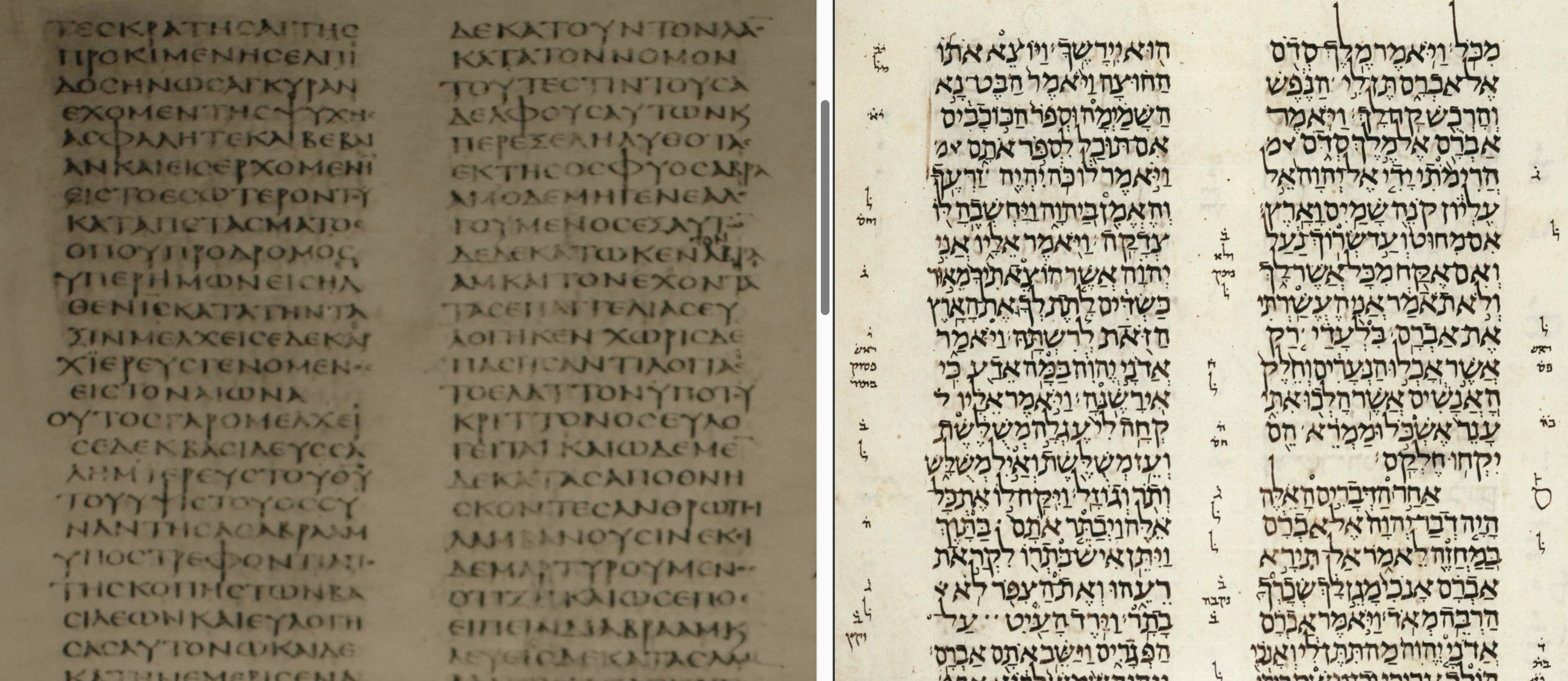
Without Genealogy
The fact that Hebrews says Melchizedek is “without genealogy” (ἀγενεαλόγητος) indicates how he is thinking and speaking. It shows you he is thinking textually. To “not have a genealogy” shows you the author is thinking about Melchizedek as a character in the book of Genesis. What else could it mean to “not have a genealogy” except to not have a genealogy included in a particular book that normally does include genealogies of important people, a book like Genesis. People don’t carry around genealogies in their pockets, but they do have them in Genesis (for example, Gen 5:1ff.; 11:10ff.; 25:1ff.).
So when the author of Hebrews says “without father and without mother” it is natural to understand these words textually too. He doesn’t have a father or mother mentioned in the text of Genesis. The author is inviting you to think about the character of Melchizedek as he appears (and disappears!) in the narrative world of Genesis.
Resemblance
Notice how the author says Melchizedek resembles (ἀφωμοιωμένος) Jesus. This too makes clear how the author is thinking about the Melchizedek-Jesus connection. He is thinking figuratively or typologically. He’s thinking about a narrative analogy between Melchizedek and Jesus. It doesn’t matter what your preferred term is to describe this textually-minded way of relating the two characters — whether narrative analogy or typology or figuration. At the very least, we can say that the author is thinking textually about a way in which the stories and characters have matching patterns. Melchizedek is “one who pattern matches” (ἀφωμοιωμένος) with Jesus.2
What Matters
These sorts of pattern matches are part of what the author means in Hebrews 2:1 when he says “we must pay closer attention to what we have heard.” For the author of Hebrews, thinking textually isn’t just stuff for Bible nerds. It’s deeply practical.
In 3:1, he urges readers to consider a pattern match between Jesus and Moses because doing so is a matter of life or death. Thinking about how Moses and Jesus are typologically related is a means to the end of helping readers hold to their confidence and hope in Jesus (3:6).
In 5:11, the author says he has a lot to say about Melchizedek, but “it is hard to explain because” his audience is “hard of hearing.” They apparently don’t have the interest and/or patience for listing to such textual reasoning. Narrative analogies are not entertaining enough for them, but the author takes them there anyway!
In 6:1 he says,
Let’s leave the elementary message about Christ and move towards maturity, not laying again a foundation of repentance from dead works and faith in God … (Hebrews 6:1)
And so he does move on in chapter 7. We are back to where we started. In 7:3, he makes clear that he is thinking about the character of Melchizedek in the book of Genesis. He’s thinking about how Jesus fulfills the biblical patterns in Melchizedek’s story.
Conclusion
For the author of Hebrews, the ability and willingness to think figurally about the Old Testament is a matter of maturity. He doesn’t mean that every person who likes to talk about typology is a mature Christian, but he does seem to mean that thinking deeply about how the Old Testament relates to Jesus is an important way to deepen one’s faith in Christ. It’s a really big deal. It isn’t about being “scholarly” or “academic.” It’s utterly practical.
Now the point in what we are saying is this: We have such a high priest, one who is seated at the right hand of the throne of the Majesty in heaven. (Hebrews 8:1)
For this author, learning to read the Old Testament figurally is a path towards deeply knowing God and his love. Thinking typologically provides confidence to enter God’s presence and receive help from him (Hebrews 4:14–16; 10:19–25). It’s a path to communion with God.
Footnotes
- The manuscript images are from modules available in Accordance Bible Software: Greek MSS Images from CSNTM and Leningrad Codex Images. ↩
- I prefer the simple term “pattern matching” because I find that it is more easily understandable to students. For recent books that use all these terms with slightly different nuances but much conceptual overlap, see the following: Don C. Collet, Figural Reading and the Old Testament: Theology and Practice (Baker Academic, 2020); James M. Hamilton Jr., Typology: Understanding the Bible’s Promised-Shaped Patterns (Zondervan, 2022); Seth D. Postell, The Art of Narrative Analogy: Identifying and Interpreting Parallel Passages in the Bible (Baker Academic, 2025). ↩
 Brian W. Davidson
Leave a comment