God gave Israel a priesthood and sacrifice rituals to lead them into his life-giving presence. In the book of Judges, a priestly theme runs through the stories to highlight Israel’s descent into death. Jephthah offers up his only child as an ascension offering. This is the death knell. In Judges, Israel becomes the land of the walking dead.
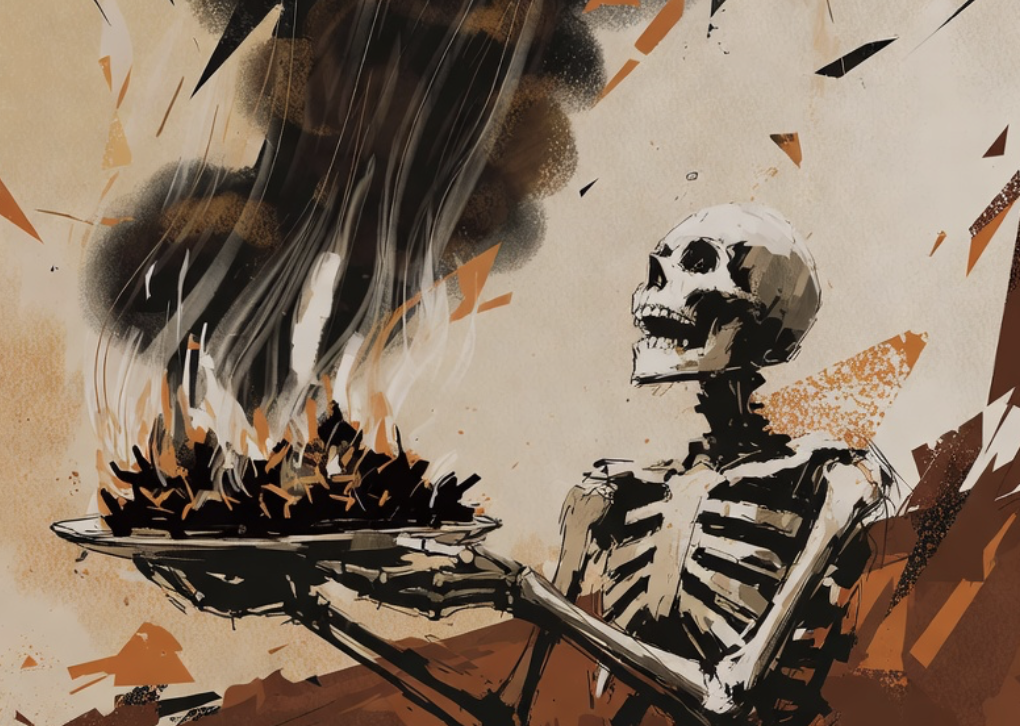
Ascension Offering
Leviticus opens with a description of Israel’s ascension offering, an offering rich with symbolism, a proclamation of truth about God, humanity, and the nature of salvation. In the “burnt offering” (עֹלָה, literally “ascension offering”), a blameless, male animal was killed and “turned to smoke” (הִקְטִיר) to ascend into Yahweh’s presence as a delightful offering (Leviticus 1:3–9). The innocent, blameless life of the animal was a gift, a delightful offering to Yahweh, given on behalf of a mere imperfect human.
Watch as the priestly theme develops and is twisted and perverted in the stories of Gideon, Abimelech, and Jephthah, who offers an inverted ascension offering, more fittingly called a descension offering.
The Problem
Judges is clear about Israel’s problem. After Joshua’s death “they abandoned Yahweh, the God of their fathers, who had brought them out of the land of Egypt” (Judges 2:12). Yahweh is the source of life and flourishing. His presence was Moses’s power: “But I will be with you” (Exodus 3:12). This was Joshua’s hope and power, too (Joshua 1:5).
Israel abandoned God’s presence and power, and they opened themselves up to the oppression of the surrounding nations. The reason is clear: They abandoned their source of life and opened the door to death.
Gideon’s Ephod
Gideon’s story is a story of compromise. This is where the priestly pattern begins. God told Gideon, just like he did Moses and Joshua, to depend on his presence and power: “But I will be with you” (Judges 6:16). Gideon continued to doubt and ask for signs, but the LORD worked through Gideon for the benefit of his people.
Hints of compromise are scattered throughout Gideon’s story, but the issue is crystal clear his final episode. Gideon takes the crescent ornaments of idolatrous kings, he collects gold from the people of Israel, and he makes his own priestly ephod (Judges 8:27). Echoes of Aaron’s golden calf are loud and clear. Gideon’s ephod became a stumbling block for Israel, just like the golden calf:
All Israel whored after it there, and it became a snare to Gideon and to his family. (Judges 8:27)
Abimelech’s Altar
Gideon’s son, Abimelech, escalates the dark, priestly pattern. To consolidate power, Abimelech slaughtered seventy of his brothers “on one stone” (Judges 9:5).
Why the added detail that Abimelech murdered all his brothers “on one stone”? The bloody scene is portrayed like as an altar. First, Gideon makes an idolatrous ephod, and then Abimelech slaughters seventy of his brothers on a stone “altar.”
Jephthah’s Descension Offering
This brings us to Jephthah story, where the pattern peaks. With the threat of battle looming, Jephthah vows that if Yahweh will empower him, he will offer up as a “burnt offering” (עֹלָה, literally “ascension offering”) whatever comes out of his front door when he returns home (Judges 11:30).
First, Jephthah is a fool for making such a rash vow; he’s twice the fool for following through with it. When he returns home victorious, the first innocent life to walk out of his front door is not ox or goat. It’s his only child, his daughter.
Jephthah “did with her according to his vow that he had made.” (Judges 11:39)
The language is clear: Jephthah offered up his only child as an ascension offering, ending his family line. Nothing could be more displeasing to the Yahweh. The story is thick with confusion and flat out ignorance of who Yahweh is and what pleases him. Israel has truly abandoned the LORD. They plunged themselves into repeating cycles of death. Unfortunately, the story will only get worse before it gets better.
Conclusion
The wording of Jephthah’s vow (Judges 11:30) and the description of his actions when he returned home (Judges 11:39) make clear that Jephthah killed his own daughter. The priestly pattern of death reinforces the point. Gideon made an idolatrous priestly ephod, Abimelech slaughtered his brothers on a stone “altar,” and Jephthah offered up his only child as an ascension offering, more fittingly called a descension offering.
At this point in the story, Israel has forsaken Yahweh and descended into the realm of death. Some say there are no zombies in Scripture, but I think the author of Judges would beg to differ. By walking away from Yahweh, Israel became the land of the walking dead.
Next post: The Judges Autopsy
 Brian W. Davidson
Leave a comment