Even in a noisy coffee shop, like the one I’m sitting in as I write these words, if you open your Bible to Jeremiah 7 and read, you can hear the voice of the Messiah: “Listen to my voice and live!” As you read, knowing how the story plays out — judgment is coming; they won’t listen — images of the Messiah rise from the pages. Jesus intentionally quoted and acted out Jeremiah 7 in more ways than one. Jeremiah’s message to Judah was a dark message of judgment, but meditating on these words in light of Jesus leads to wisdom and hope.

Whose Voice?
In chapter 7, Jeremiah stands at the temple gate and cries for Jerusalem to make a choice. They can “stay in the garden” with God or define good on their own terms. This is what Yahweh says:
Make your ways and your works good, and I will dwell with you in this place. (Jeremiah 7:3)
Like Adam and Eve in the garden and like Cain in Genesis 4, Jerusalem has a choice to make. Their choice has everything to do with whose words they choose to listen to and trust:
Don’t trust lying words saying, “The temple of Yahweh! The temple of Yahweh! The temple of Yahweh!” (Jeremiah 7:4)
No building or ritual in-and-of itself leads to life. Listening to Yahweh’s voice, his Torah, summarized in the double love command, leads to life.
Instead, truly make your ways and your works good! If you actually do what’s right for your neighbor and you don’t oppress the sojourner, the orphan, the widow, and you don’t pour out innocent blood in this place and go after other gods to your own harm, then I will dwell with you in this place, in the land which I gave to your fathers forever and ever. Look, you trust lying words and it doesn’t even help you! (Jeremiah 7:5–8)
Jeremiah is saying, “For the love of God and for the love of dwelling with him, do what is good for people because this is what is good for you.” His message sounds a lot like Jesus’s double love command (Matthew 22:37–40), and as we keep reading the voice of the Messiah will become louder and louder.
The Voice of the Messiah
The people commit injustice and then enter the temple and act like everything is OK (7:9–10). Jeremiah words should sound familiar here:
A hideout for thieves? Is this what this house called by my name has become in your eyes? (Jeremiah 7:11)
In Matthew 21, Jesus enacts and quotes Jeremiah 7. He enters the temple court, turning over tables and yelling, while quoting both Isaiah and Jeremiah’s words:
My house will be called a house of prayer, but you make it a hideout of thieves! (Matthew 21:13)
Recognizing that Jesus is drawing from Jeremiah fills out his words with the context of Judah’s exile. In Jeremiah, Judah and Jerusalem were about to be conquered and their people exiled. By quoting Jeremiah, Jesus is saying that the Jerusalem of his day was in the same situation. They are on the brink of judgment. The patterns of exile and exodus are playing out again.
The Hebrew Bible ends with the decree for God’s people to go up and rebuild the house of Yahweh (2 Chronicles 26:22–23). They certainly did rebuild (Ezra-Nehemiah), but as the rest of Matthew (and the other Gospels) makes clear, the real, actual, true exodus and regathering of God’s people began to take place through Jesus, the Messiah. The Spirit dwells in him; his body is the true temple through which the Spirit flows.
Judah rebuilt the temple after some returned from exile, but even at that time prophets like Haggai pointed to a coming glorification of the temple:
This is what Yahweh of Armies says, “Yet once more, in a little while, I will shake the heavens and the earth and the sea and the dry land, and I will shake the nations and the delight of all nations will come. I will fill this house with glory,” says Yahweh of Armies. “To me belong silver. Gold is mine,” declares Yahweh of Armies. “The latter glory of this house will be greater than the former,” says Yahweh of Armies. “And in this place I will establish peace,” says Yahweh of Armies. (Haggai 2:6–9)
The new creation vision of the prophets began to be realized in and through the incarnation of the Son. Through him flows the Spirit that brings exodus, life, and the glory of God. The “latter glory” of the temple Haggai spoke about is the body of Jesus.
Jesus quotes and enacts Jeremiah 7 to say that the Jerusalem of his day was corrupt because they had not recognized the time of their visitation.1 They rejected the him, and they filled the temple with similar forms of injustice and false hopes.

Yahweh’s Voice
The Messiah quotes Jeremiah, but there’s more to it than that. The Spirit of Christ lived and spoke long before Jeremiah 7. Jesus didn’t just quote Jeremiah. Jeremiah spoke the words of given to him by the Spirit of Christ. Since the garden, the triune God has been calling his people to listen to his voice so that he can lead them towards what is good.
The next section of Jeremiah 7 is bookended with the phrase “early and often” (יוֹם הַשְׁכֵּם). Early and often, Yahweh spoke to his people (7:13, 25), but they refused to listen to Yahweh’s voice. As a result, says Jeremiah, they are headed for exile (7:12–18). It’s a done deal and nothing will change it. In a sense, for Jeremiah and his day, the next several verses are a lament. The prophet laments how God’s people have failed to listen to his voice from the Exodus to the final days leading up to Judah’s exile.
For readers of the Hebrew Bible, however, these words are wisdom, not just lament. In fact, in this center section of Jeremiah 7, you can hear the heartbeat of biblical theology. In a previous post, I wrote about how the theme of obedience-disobedience is intertwined throughout the Old Testament story with the hope of a coming Messiah:
Throughout the story, the theme of obedience is signaled with the words “listening to Yahweh’s voice.” The paradigm of obedience-disobedience is built on שׁמע and קוֹל. “Listening to the voice” is the motif. Obedience-disobedience is the theme. The plot is driven forward as humanity vacillates between obedience and disobedience and we all wait for the arrival of the promised seed, the Messiah who will truly listen to Yahweh’s voice.2
Jeremiah is familiar with this whole Bible theme. In that post, I highlighted over forty places where “listening to Yahweh’s voice” appears in the biblical story from the garden to the exile of Israel. Jeremiah picks up where 2 Kings leaves off, and he takes the next step. He applies the same critique to Judah and Jerusalem. Like Samuel earlier, Jeremiah juxtaposes (a) the ritual practice of giving offerings and sacrifices with (b) listening to Yahweh’s voice.3 If you neglect Yahweh’s voice and do what is good in your own eyes, the ritual offerings are worthless.
Jeremiah 7:23 is clear wisdom for today. Note the way Jeremiah frames the motivation.
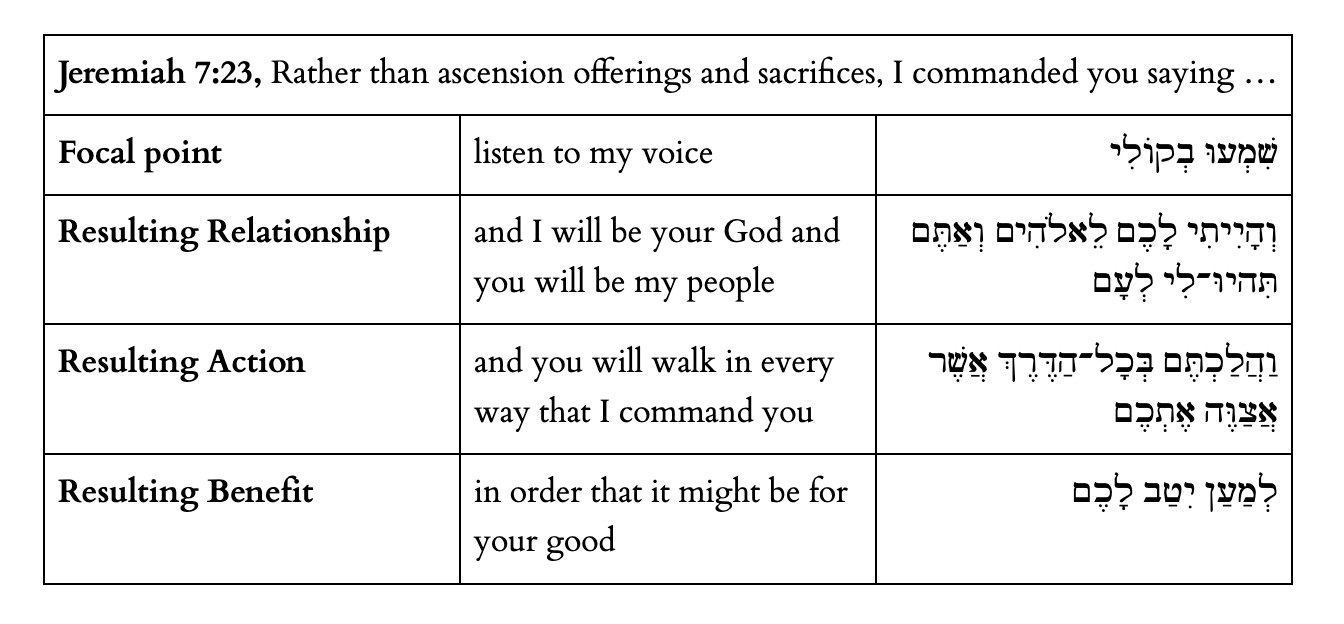
Judah didn’t listen (7:24, 26, 27, 28). We don’t have to follow that path. We can follow the Messiah and let him and his Spirit lead us into new creation.4
Concluding Reflection
It could be easy to hear Jeremiah’s words and turn away because you recognize your own patterns of failure in Jeremiah’s portrait of Israel and Judah. But you don’t have to go there. You can read Jeremiah 7 and ponder the hope we have in Jesus. Jesus’s voice echoes throughout Jeremiah 7; images of his fulfillment of these verses are reflected on each page.
The seed of the woman and Abraham and David has come, and he did actually “make his ways and works good.” He listened to his Father’s voice without fail. He refused to listen to the snake in the garden and in the wilderness. In Matthew 4, the Messiah quoted Deuteronomy over and over, telling the snake that listening to the Father’s voice was more important than the hunger he felt in his stomach. In the garden, he said the words no other human has ever said so whole-heartedly and consistently, “Father, not my will but yours” (Matthew 26:39, 42, 44).
We haven’t lived this way, but he did. In this life, I don’t expect to ever completely become the whole-hearted, flawlessly obedient person that the Messiah is. I do, however, know that meditating on him and listening to his words — this is the path to growing into a fruitful tree planted by streams of water.5
Blessed is the man … who meditates on the Torah day and night. He’s like a tree planted by streams of water. He produces his fruit in season, and his leaves do not wither. In all that he does he prospers. (Psalm 1)
I’m reminded that Jesus is the righteous branch (Jeremiah 23:5–6; 33:14–18), the one marked by the sevenfold Spirit of God (Isaiah 11:1–2), and he encourages us to ask the Father for his Spirit of wisdom:
So if you who are wicked know how to give good gifts to your children, how much more will the Father give from heaven the Holy Spirit to those who ask him! (Luke 11:13)
Jesus ascended to the right hand of the Father to give the Spirit to those who come to him. Jesus is the door through which we can approach God with confidence (Hebrews 10:19–22). We don’t have to read Jeremiah 7 and look down with shame because of our own imperfections. Jesus is the delightful sacrifice, the obedient life who ascended to the Father on our behalf (Hebrews 7).6
Because of him, we have hope of moving forward (Hebrews 4:16). We won’t always be like we are now.
We are children of God now, and what we will be has not yet appeared. We know that when he appears, we will be like him because we will see him, just as he is. (1 John 3:2)
There’s hope for the day he returns, but there’s hope for today, too. Since I began writing this post, I packed up my things at the coffee shop and drove home. I’m sitting in my tiny, corner-of-the-bedroom office with my sweet cat, Penny, in my lap. My cat communicates with me every day. She tells me when she wants a door open and when she wants to go outside. She tells me when I forget to give her treats and when she wants to play. If my cat can communicate with me, how much more can the triune God speak and guide and lead us, the one who Created this complex world and sustains it with the word of his power.
Because the Messiah listened to the voice of the Father, we can have confidence that he wants to guide us by his Spirit and help us grow into his image and likeness, from today all the way until that day when we see him as he is.
Prayer
Lord, have mercy and help us listen. Holy Spirit, empower our imagination to see beyond the paths we’ve walked before. Help us to see the way of Jesus in our cluttered, dimly lit lives. Help us find the way forward and not backwards, Father.
Footnotes
- See the language of Luke 19:44, where Jesus weeps over Jerusalem and says, “For the days will come upon you, when your enemies will set up a barricade around you and surround you and hem you in on every side and tear you down to the ground, you and your children within you. And they will not leave one stone upon another in you, because you did not know the time of your visitation” (ESV). ↩
- The motif of “listening to the voice of Yahweh” runs throughout the Old Testament story. See Listening to the Voice of Yahweh: The Theme that Drives the Plot. ↩
- See 1 Samuel 15:22 — “Does Yahweh delight in ascension offerings and sacrifices in the same way he delights in listening to the voice of Yahweh? Look! Listening is better than sacrifice! To pay attention is better than the fat of rams!” ↩
- In a previous post, I highlighted how the goal of following Jesus is not suffering. Suffering is the path, but the ultimate goal is new creation. See Suffering is Not the Goal: Following Jesus into New Creation in Luke 9. ↩
- Luke’s Sermon on the Plain portrays Jesus as the τέλειος ἀνήρ, the whole person. See this post: Luke’s Implied Reader and James’s τέλειος ἀνήρ. Jesus calls his disciples to follow him towards wholeness. There is hope of moving in that direction. ↩
- See this post for more on Hebrew 7 and Jesus’s priesthood, Jesus-Melchizedek: Four Pattern Matches ↩
 Brian W. Davidson
Leave a comment