In Psalm 12, David leads us to see that God’s words are more real than the smooth words we hear from the enemy. He recognizes how easy it is to believe that (1) human strength is ultimate and (2) the needy have no help.
The wicked speak double-minded lies, but there’s a better word. David invites us to listen to God’s pure, smelted, refined speech. At the heart of Psalm 12 lies the gospel of “God with us.” The hope is utterly supernatural: God sees and hears. He will rise and act on behalf of those who take refuge in him.
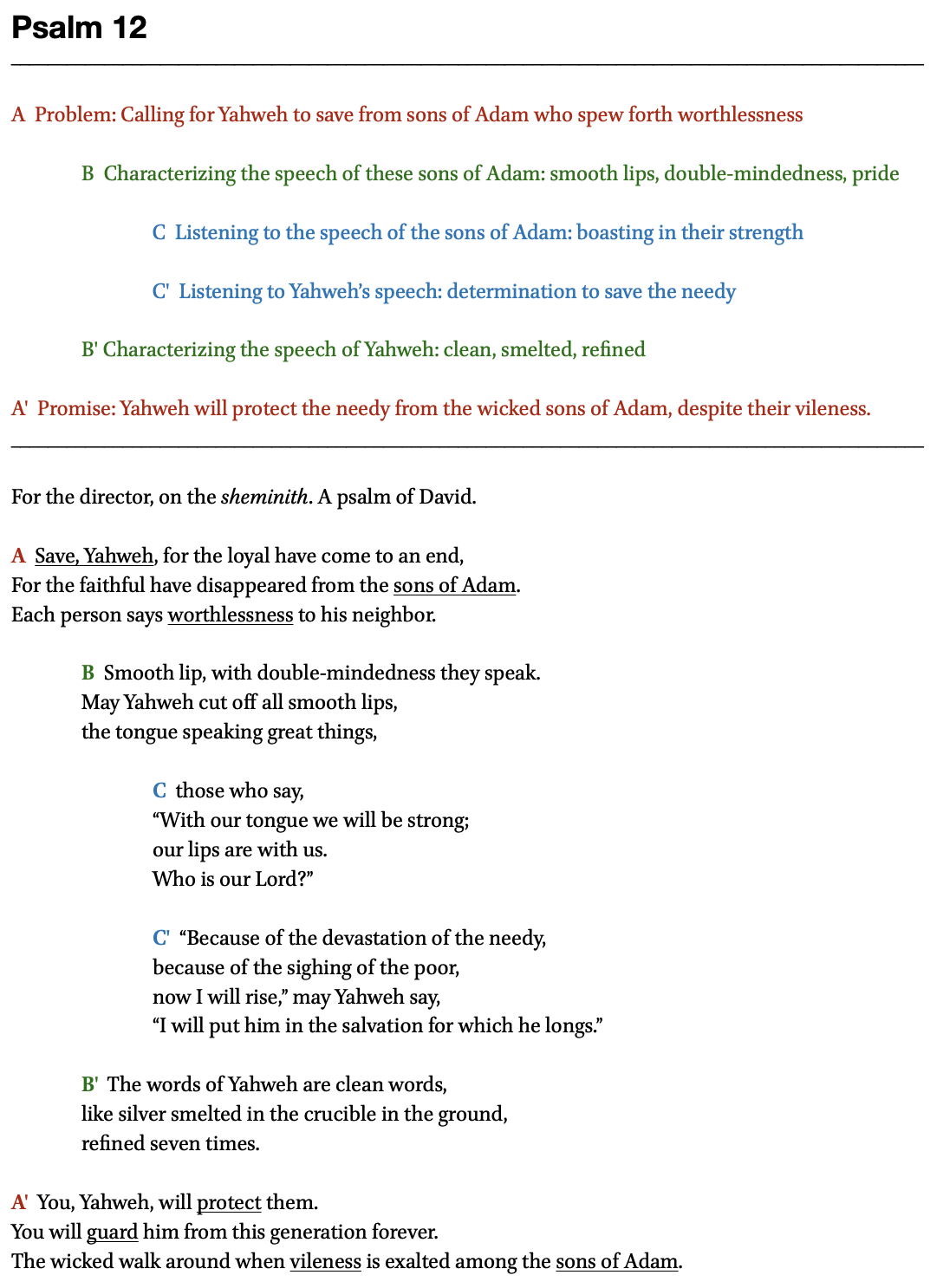
A–Aʹ
The first and last sections of Psalm 12 are connected by three things:
- The hope of Yahweh’s salvation (save, protect, guard)
- The threat of certain “sons of Adam”
- Worthlessness and vileness spewing forth from (A) and surrounding (Aʹ) the sons of Adam
David wants us to learn from his own struggles. He calls to Yahweh for help because he feels alone, like all the loyal and faithful have disappeared (A). All that’s left are wicked sons of Adam who use their mouths to spew forth worthlessness (שָׁוְא) like a flood.
In the next few paragraphs, readers will walk with David through his description of those he dreads (B, C) and his rehearsal of God’s promises (Cʹ) and character (Bʹ). The concluding section calls readers to hope, like David, that Yahweh will get up and help those who call out to him from help. Though vileness (זֻלּוּת) rises and fills the air like a plague of darkness, Yahweh will guard those who call out to him, just as he protected Israel from the plagues in Egypt.
B–Bʹ
In the second (B) and next to last (Bʹ) sections, David rehearses what is true about the speech of the wicked and the speech of Yahweh.
It’s easy to hear the words of the enemy and conclude that those words are more real than God’s words. The lie and the liar are easy to believe, and that’s why David describes the wicked as having a “lip of smooth things” (שְׁפַת חֲלָקוֹת, ESV: flattering lips). They speak with “a heart and a heart” (בְּלֵב וָלֵב, ESV: a double-minded heart). They don’t make clear the destructive end of their speech.
Yahweh’s speech, however, is not double-minded. It’s pure, smelted, and refined. What you hear from him is whole-hearted and true. You can take his words at face value. You can rest your weary soul on Yahweh’s words.
With these interpretive guardrails in place, David invites you to listen to speech of both the wicked and Yahweh.
C–Cʹ
The words of the wicked provide the black backdrop that makes Yahweh’s words shine with gospel hope. First, listen to the “great things” of the wicked. This is the dark black backdrop:
“With our tongue we will be strong;
our lips are with us.
Who is our Lord?”
The wicked boast of their own strength and cunning, but as David knows from Hannah’s song, “Not by might shall a main prevail.” Rather, Yahweh “will guard the feet of his faithful ones” (1 Samuel 2:9). The wicked believe there is no one above them — no Lord, no God to whom they must submit. This tangible, natural perspective is sometimes easier to believe than the gospel, which is supernatural from start to finish.
Now, contrast Yahweh’s pure speech. Here’s the bright light of gospel hope:
“Because of the devastation of the needy,
because of the sighing of the poor,
now I will rise,” says Yahweh,
“I will set him in the salvation for which he longs.”
Though vileness rises all around (Psalm 12:8/9, כְּרֻם זֻלּוּת), Yahweh sees those who need help. He hears their sighing, and he gets up: “Now, I will rise, says Yahweh” (עַתָּה אָקוּם, Psalm 12:5/6). Just as Stephen saw Jesus standing to help him in the midst of his suffering, so also Yahweh promises to stand and help the faithful.1 As Jesus has shown us, the Father can send his Spirit to sustain us as we walk up to and through misunderstanding, slander, suffering, and death.
Those who recognize they are needy have a hope you can’t see. By recognizing our neediness, taking refuge in God and his Son, and talking to him, we can trust, like David, that God will get up and help us. Our longings for his salvation are faithful guides because when he rises he will say to the needy, “I will set him in the salvation for which he longs.”
☩ We believe, Lord. Help our unbelief. ☩


Leave a comment