Ezekiel helps us see the messianic vision of the Torah, Deuteronomy in particular. In this post, I want to try to show three things:
- Deuteronomy 4:25–31 makes clear that Moses writes with an eye towards the time of the Messiah.
- Ezekiel interacts with Deuteronomy 4:25–31 and adds to its messianic hope.
- The way Ezekiel interacts with Deuteronomy helps us read Deuteronomy. It makes more explicit that Deuteronomy is written to cultivate hope in a coming Messiah.
Deuteronomy 4:25–31 — Writing for the “Latter Days”
I get excited to show students that Deuteronomy is written with an eye towards the distant future because it helps students see that Deuteronomy is relevant to them. Moses intended Deuteronomy to speak to generations far beyond his original readers. Listen for the way Moses writes with an eye towards the distant future.
When you father children and children’s children, and have grown old in the land, and you act corruptly by making a carved image in the form of anything, and by doing what is evil in the sight of the LORD your God, so as to provoke him to anger, I call heaven and earth to witness against you today, that you will soon utterly perish from the land that you are going over the Jordan to possess. You will not live long in it, but will be utterly destroyed. And the LORD will scatter you among the peoples, and you will be left few in number among the nations where the LORD will drive you. And there you will serve gods of wood and stone, the work of human hands, that neither see, nor hear, nor eat, nor smell. But from there you will seek the LORD your God and you will find him, if you search after him with all your heart and with all your soul. When you are in tribulation, and all these things come upon you in the latter days, you will return to the LORD your God and obey his voice. For the LORD your God is a merciful God. He will not leave you or destroy you or forget the covenant with your fathers that he swore to them. (Deuteronomy 4:25–31)
He writes with an eye towards “the latter days,” and he makes clear in this passage what that phrase means.
The Meaning of “the Latter Days”
The phrase “latter days” (באחרית הימים) is an important one for Moses and the prophets. Moses uses the language to frame three of the four major poems of the Torah.1 The prophets use the phrase to point ahead to a time of restoration and renewal.
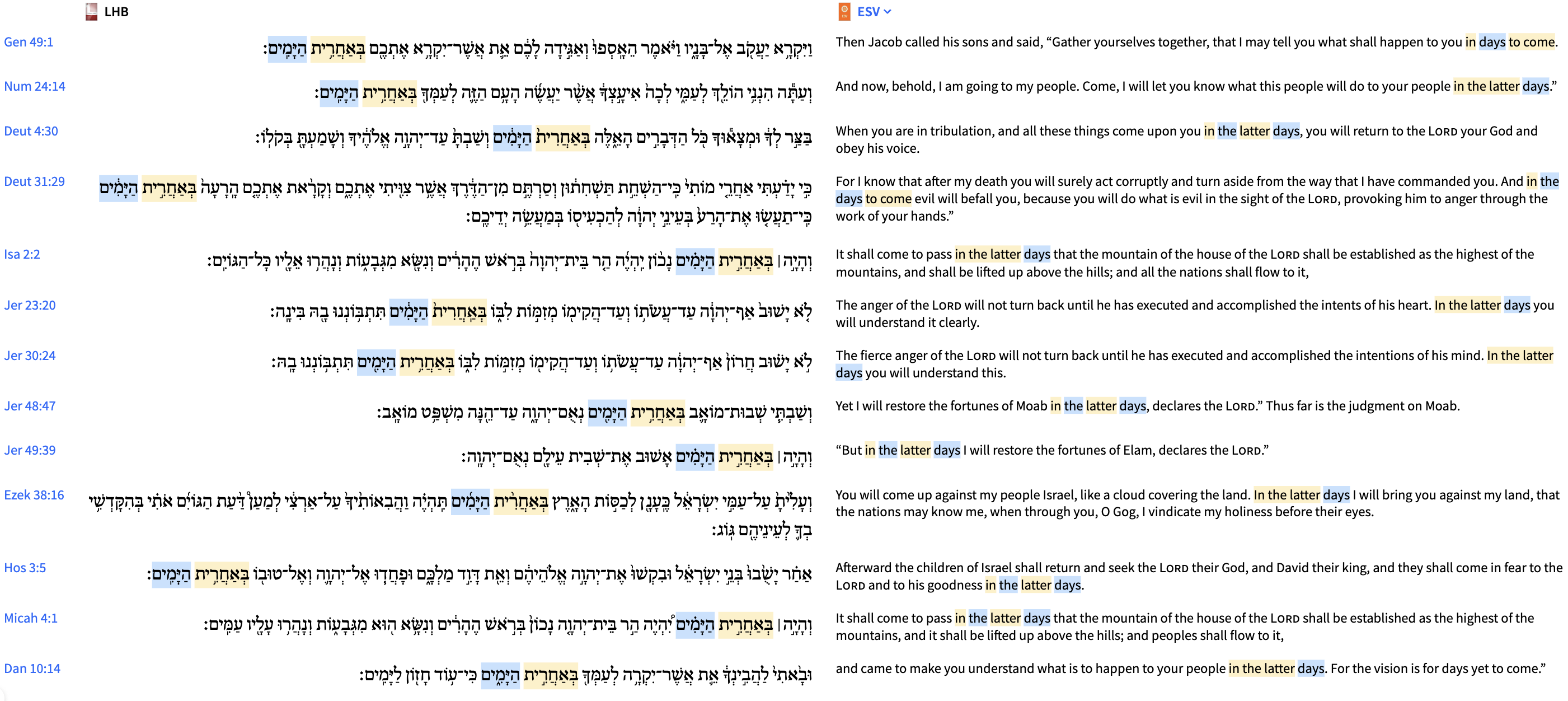
What exactly do Moses and the prophets mean by “latter days”? The answer is here in Deuteronomy 4:25–31. The latter days” (באחרית הימים) refers to a time after …
- Israel perishes from the land (4:26)
- They are scattered among the peoples (4:27)
- The LORD drives Israel into the nations (4:27)
“The latter days” is a time during Israel’s exile, the era at the end of 2 Kings. But there’s more to it. It’s not just the “time of the exile.” It’s a time that extends deep into the darkness of exile.
A Time of Repentance Deep within the Era of Exile
According to Moses, the “latter days” is a time during the exile when some of God’s people will “seek the LORD” and “search after him with all their heart and soul.” It’s a time of repentance, when his people “return” (Deut 4:30, שׁוּב).
The prophets echo this call throughout their writings:
Yet even now, declares the LORD, return to me with all your heart … rend your hearts and not your garments. Return to the LORD your God, for he is gracious and merciful, slow to anger, and abounding in steadfast love; and he relents over disaster. (Joel 2:12–13)2
From the days of your fathers you have turned aside from my statutes and have not kept them. Return to me, and I will return to you, says the LORD of hosts. But you say, ‘How shall we return?’ (Malachi 3:7)
In Deuteronomy 4, Moses looks deep ahead into the era of the exile and points to a day when God’s people will respond to the prophets call to repentance. The rest of the canon makes clear that this era of repentance and restoration comes to fruition when the Messiah steps onto the scene.
It’s no coincidence that the Gospel writers summarize the early preaching of John and Jesus this way: “Repent for the kingdom of heaven/God has come near” (Matthew 3:2; 4:17; Mark 1:15). Israel’s era of repentance and regathering begins when the Messiah steps onto the scene and pours out God’s Spirit from on high (Acts 2).
Deuteronomy’s “latter days” is the time of the Messiah, and Ezekiel makes this even more explicit. To Ezekiel we now turn.
Ezekiel 11:14–21 — Amplifying the Messianic Hope of Deuteronomy 4
Ezekiel picks up what Moses laid down in Deuteronomy 4 and makes the messianic time frame more explicit. Moses talked about an era of repentance, but Ezekiel adds two more explicitly messianic hopes to the thought world of Deuteronomy 4: the outpouring of God’s Spirit and the promise of heart circumcision.
As you read the passage below from Ezekiel 11, listen for the time frame sounds similar to that of Deuteronomy 4.
And the word of the LORD came to me: “Son of man, your brothers, even your brothers, your kinsmen, the whole house of Israel, all of them, are those of whom the inhabitants of Jerusalem have said, ‘Go far from the LORD; to us this land is given for a possession.’ Therefore say, ‘Thus says the Lord GOD: Though I removed them far off among the nations, and though I scattered them among the countries, yet I have been a sanctuary to them for a while in the countries where they have gone.’ Therefore say, ‘Thus says the Lord GOD: I will gather you from the peoples and assemble you out of the countries where you have been scattered, and I will give you the land of Israel.’ And when they come there, they will remove from it all its detestable things and all its abominations. And I will give them one heart, and a new spirit I will put within them. I will remove the heart of stone from their flesh and give them a heart of flesh, that they may walk in my statutes and keep my rules and obey them. And they shall be my people, and I will be their God. But as for those whose heart goes after their detestable things and their abominations, I will bring their deeds upon their own heads, declares the Lord GOD.” (Ezekiel 11:14–21)
Like Moses, Ezekiel writes with an eye towards God’s people scattered among the nations. Like Moses, he speaks about a time marked by repentance, but he adds the hope of humanity having a new heart and a new spirit.
There are at least four reasons why I think Ezekiel has Deuteronomy 4 in mind and is intentionally adding to the messianic hope of that passage.
Reasons for Thinking Ezekiel is Interacting with Deuteronomy 4:25–31
In light of the fact that Ezekiel is a priest (Ezek 1:3) and a prophetic author of Scripture, I assume that he is familiar with the Torah of Moses. Of course everything about how the Bible was written is debatable, but I think Ezekiel’s familiarity with the Torah is ultimately undeniable. But what does Ezekiel 11:14–21 have in common with Deuteronomy 4:25–31?
Common Audience and Problem: Scatter
In Deuteronomy 4:27, Moses addresses his words to a people whom “the LORD will scatter (פוץ)” among the peoples. Ezekiel message is addressed to the same audience with the same problem (Ezekiel 11:17): “Thus says the Lord GOD: I will gather you from the peoples and assemble you out of the countries where you have been scattered (פוץ).”
Common Comfort: Return and Gather
Moses tells the exilic community that there is hope: “You will return (שׁוּב) to the LORD your God and obey his voice.” Ezekiel relays a similar message from Yahweh, “I will gather (קבץ) you from the peoples.” The people’s return to the LORD (Moses) goes hand-in-hand with their regathering from among the nations (Ezekiel).
Common Solution: Heart
According to Moses, the exilic community will return to the LORD when they search after him with all their heart (Deut 4:29, לֵבָב). Ezekiel says they will remove the detestable things and receive a new heart (Ezek 11:19, לֵב). Later passages in Ezekiel indicate that “removing detestable things” and “receiving a new heart” are not two separate things. They’re directly related because the people’s problem is that they “have taken their idols into their hearts” (Ezek 14:3).
Moses’s “return to the LORD” (Deut 4:30) is spoken of by Ezekiel as “removing” detestable things (Ezek 4:18), but both speak about return and removal in terms of the heart. Obedience is a heart issue (לֵבָב and לֵב).
Common Goal: Listening
Moses says that when God’s people respond to God with all their heart, they will “listen (שׁמע) to his voice.”3 Likewise, Ezekiel says that when God’s people receive a new heart, they will walk (הלך) in his statutes, keep (שׁמר) his rules, and do (עשׂה) them. Ezekiel expounds on the “listening” Moses writes about with three related terms: walking, keeping, doing.
These are the reasons why I think it makes sense to understand Ezekiel 11:14–21 as a development of the same thought as Deuteronomy 4:25–31. Ezekiel is knowledgeable of Moses’s Torah, he addresses a common audience and a common problem with a common comfort, solution, and goal.
Ezekiel’s Two-Point Addition
Recognizing that Ezekiel is interacting with Deuteronomy 4:25–31 sets you up to hear two additional messianic hopes — renewal of the human heart and the gift of the Spirit — alongside the hope of repentance, which Moses wrote about in Deuteronomy 4.
And I will give them one heart, and a new spirit I will put within them. I will remove the heart of stone from their flesh and give them a heart of flesh … (Ezekiel 11:19)
The outpouring of the Spirit is something Moses longed for and spoke about in Numbers 11:29. Isaiah associated the Spirit with the Messiah (Isaiah 11:1–2. Isaiah spoke about a time when the Davidic king would come and the Spirit would be poured out from on high (Isaiah 32:1, 15).
Ezekiel wants us to recognize that all three of these hopes — the repentance, the renewal of the human heart, and the gift of the Spirit — will be realized within the same time frame Moses wrote about in Deuteronomy 4:25–31. The time of the Messiah, “the latter days” (Deut 4:30), is an era of repentance (Moses), human heart renewal, and the gift of the Spirit (Ezekiel). Ezekiel 11 turns up the volume of messianic hope in Deuteronomy 4.
Conclusion
Deuteronomy 4:25–31 characterizes “the latter days” as a time of repentance, and the rest of the canon makes clear that this time of repentance arrives when the Messiah comes. Ezekiel interacts with this text by using similar language and the same concepts to add two more explicitly messianic hopes: heart renewal and the gift of the Spirit. In this way, Ezekiel helps us see the messianic vision of the Torah. Ezekiel helps us see that Deuteronomy is written for people who are looking for and taking refuge in the Messiah. Christians, who know and love and take refuge in Jesus, can and should read Deuteronomy as their book.
- For “in the last days” in the major poems of the Pentateuch, see this post: Themes & Thesis: the Major Poems of the Pentateuch. ↩
- For more on the significance of this passage in Joel, see this post: After Decreation in Joel. ↩
- For more on how listening (שמע) to the voice (קוֹל) of the LORD is the theme that drives the plot of the Old Testament, see this post: Listening to the Voice of Yahweh: The Theme that Drives the Plot. ↩


Leave a Reply