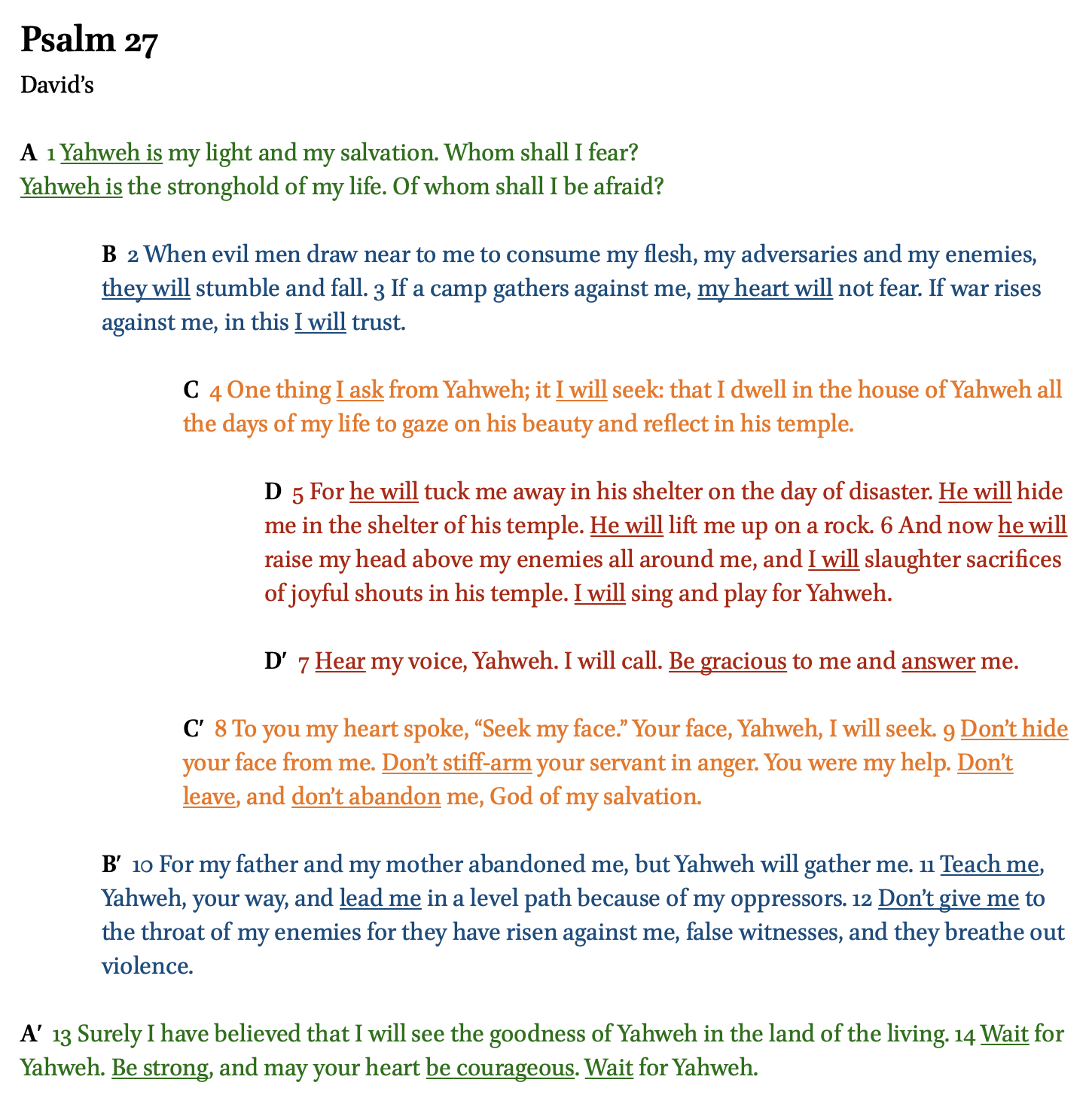
This is my attempt to describe the structure I’m seeing in Psalm 27. The structure highlights the hope we have in Yahweh himself (A-A′), even in when we feel abandoned and are surrounded by seemingly insurmountable problems (B-B′). It highlights a focal point of action: seeking Yahweh’s presence (C-C′). The central section points to the foundational hope: Yahweh himself can be a supernatural hiding place for those who seek him (D-D′).
The picture below is my translation arranged chiastically. The underlines in verses 1–6 mark indicatives; they mark imperatives in 7–14.
Overview
In the first half of Psalm 27 (verses 1–6), David rehearses what he knows to be true. In the second half (verses 7–14), he requests the LORD’s help. The first half is punctuated by indicatives; the second half is punctuated by imperatives.
- Verses 1–6 (A–D): Indicatives
- Verses 7–14 (A′–D′): Imperatives
There are eight sections in four pairs:
- A-A′: David confesses who he knows Yahweh to be (A) and he asks him for help (A′).
- B-B′: David describes his enemies and how he knows their end in light of who Yahweh is for him (B). He asks Yahweh to stay with him as he’s abandoned by his family and as enemies surround him (B′).
- C-C′: David rehearses his determination to seek the LORD’s presence (C), and he repeatedly asks the LORD to stay with him (C′).
- D-D′: The central section highlights the way David can take refuge in Yahweh (D). He petitions Yahweh to hear, be gracious, and respond (D′).
Who Yahweh Is (A-A′)
The first and last sections frame the entire psalm and are connected by the hope that is found in who Yahweh is. He is David’s light, his salvation, his stronghold (A), his goodness. David therefore closes the psalm by urging himself to wait for Yahweh and be strong and courageous (A′), echoing the words of Moses (Deut 31:6, 7, 23; Josh 1:6, 7, 9, 18).
Problem of Enemies (B-B′)
The second and second-to-last sections address the problem: evil men, enemies, adversaries (B), those who have abandoned him. In the midst of these problems, David asks Yahweh to teach him and lead him. In section B, David’s enemies seek to consume his flesh (27:2, לֶאֱכֹל אֶת־בְּשָׂרִי) so in B′ David asks Yahweh for help: “don’t give me into their throat (27:12, אַל־תִּתְּנֵנִי בְּנֶפֶשׁ צָרָי).
Seeking Yahweh (C-C′)
The third and third-to-last sections are connected by the theme of seeking Yahweh. David determines to focus on one thing: seeking Yahweh presence (C). He resolves to spend every day in the temple, reflecting on the LORD and his mighty deeds. Here, David echoes the idea of Psalm 1 and Joshua 1, both of which speak about meditating on the Torah day and night. In section C′, we hear what it sounds like for David to seek the LORD: “Don’t hide,” “don’t stiff-arm,” “don’t leave,” “don’t abandon me!” Each of these imperatives are requests for the LORD’s presence to stay with him.
Specific Help (D-D′)
The central section focuses on specific ways that Yahweh can and will help David. Yahweh will tuck David away in the shelter of his presence. He will hide him and raise him high upon a rock, as the LORD did for Noah. He carried the ark through the flood waters and caused it to rest on the top of a mountain. David asks for Yahweh to hear, be gracious, and answer. Yahweh himself is David’s hope, and the specific help David needs is for Yahweh to be a supernatural place of hiding and refuge. This section reminds me of the way Yahweh hid David from Saul in 1 Samuel 24 and 26.


Leave a comment